














 Printer Friendly Layout
 Comment No. * from: roger [Member]

May have
MCL (medial collateral ligament) strain or tear: This injury may cause pain and possible instability to the inner side of the knee.
https://www.webmd.com/pain-management/knee-pain/picture-of-the-knee#1
Valgus stress test: Pushing the calf outward while holding the thigh stable, a doctor can check for injury to the medial collateral ligament (MCL).
https://www.webmd.com/pain-management/knee-pain/picture-of-the-knee#2
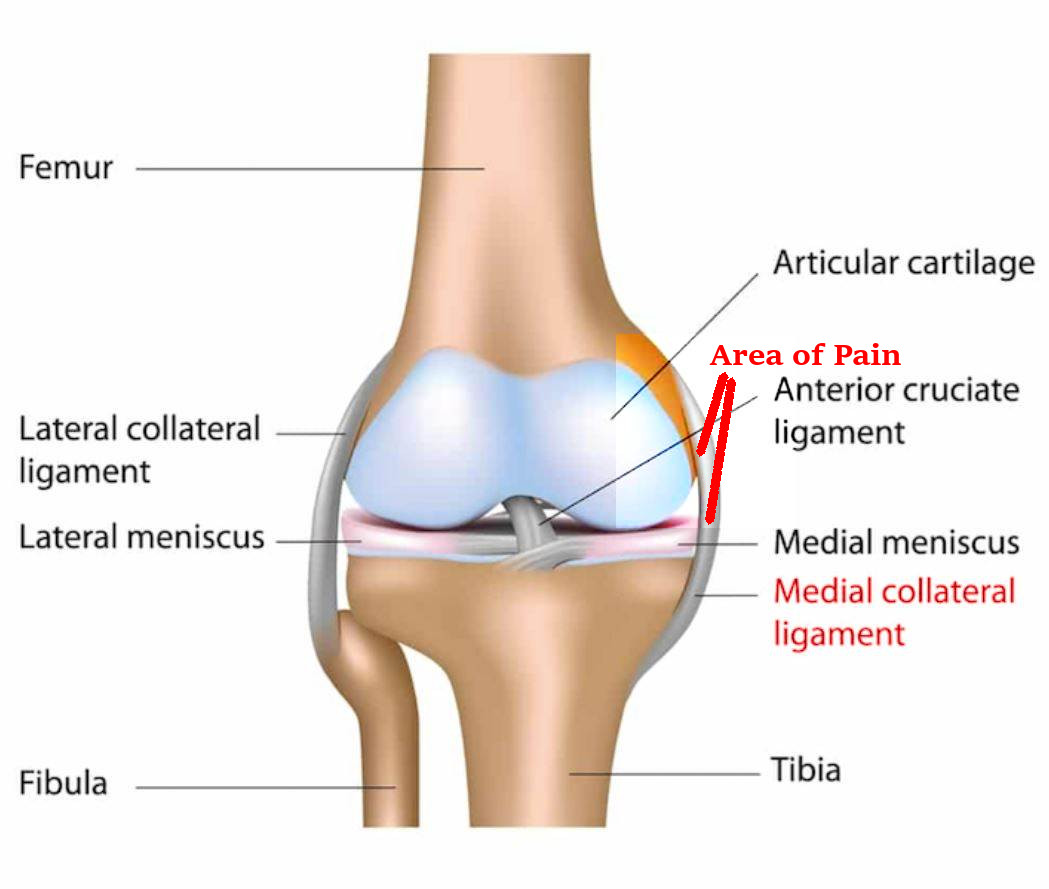
MCL injuries can be grades 1, 2, or 3:
A grade 1 MCL injury is the least severe. It means that your ligament has been stretched but not torn.
A grade 2 MCL injury means that your ligament has been partially torn. This usually causes some instability in your knee joint.
A grade 3 MCL injury is the most severe type of ligament injury. It occurs when your ligament has been completely torn. Joint instability is common in a grade 3 MCL sprain.
https://www.healthline.com/health/medial-collateral-ligament-mcl-injury-of-the-knee
How’s an MCL injury treated?
Treatment options vary depending on the severity of the MCL injury. Most MCL injuries will heal on their own after a few weeks of rest.
Immediate treatment is necessary to ease pain and help stabilize your knee. Immediate treatment options include:
applying ice to reduce swelling
elevating your knee above your heart to help with swelling
taking nonsteroidal anti-inflammatory drugs (NSAIDs) to ease pain and swelling
compressing your knee using an elastic bandage or brace
resting
using crutches to keep weight off of your injured kneeRehab
As you recover from your injury, the goal is to regain strength in your knee and prevent further injury. Treatments may include:
physical therapy to strengthen muscles and improve your knee’s range of motion
wearing a protective knee brace during physical activity
limiting activities that can cause further injury, such as contact sports


